Showing posts with label world building. Show all posts

Saturday, August 22, 2026

Seafoam Breaking On The Shore (Mottled Lands Future)

Just Now

A musican wakes up, they do not remember who they are. They climb out of a coffin to discover they lack flesh. They look at a great soft grey wall and feel something stirs in thier soul.

The Mottled Lands are a backwater of little intrest to anyone of note. There is no central government, just various independent towns and villiages eeking out a living. Long bloody generational feuds are the norm and considered preferable. It is good to suck yourself in passions and stories becouse it keeps the Fog out of your home. Traders from the Mirrored City maintain a port up here to buy furs.

A tenth of the land is lost to Deep Fog.

In A Year

A musician sits on the corner playing and hoping passers by will spare him (he decided) a few coins. He feels he's not able to convey the palpable feeling of anticipation he feels in his music.

A god-awful trapper turns out to be a good teasure hunter, finding something big in the forgotten megacity. This discovery is brought back to Mirrored City, where some very important people discover that it could change everything. Suddenly the Mottled Lands are flooded with sorcerors and graverobbers, eager to make it big.

An eighth of the land is lost to Deep Fog.

In A Decade

A musician breaks a candelabra over a soldier's head and jumps out the window. She (changed her mind) dives into the river, and curses that she's going to have to buy a new guitar.

The Mottled Land is at war with itself. The Colonial Authority, The Motley Revolutionaries, The Gnome Home, and others all via for control of the region and it's resources. Blood feuds and honor duels are no longer considered ethical. The old traditions are being cast into the Fog, and with them many settlements go as well.

A fourth of the land is lost to Deep Fog.

In A Century

A musician after many years realised what song they (settled on they eventually) have been trying to play this whole time. It is a dirge for the end of the world.

The Republic, the Seven Wizard Kings, the Eternal Emperor are all gone, all forgotten, all lost.

An small island is not yet in Deep Fog.

In ???

A musician is surprised to learn that the song turns out not to be a dirge but an encore, or even a lullaby.


Sunday, December 21, 2025

How To Change The World: A Guide for Cowards (Scenario Generator)

Recently I’ve been watching Revolutionary Girl Utena and got thinking about why Souji and Mamiya try to defeat Utena by exploiting the emotional baggage of students using corrupt flowers. Which also got me thinking about how in Miraculous Ladybug Hawkmoth uses corrupt butterflies to exploit the emotional baggage of Parisians. One can say a lot about how this trope’s utility to a story’s structure and how it fits the constraints of the medium, but this post isn’t about that. 

This is about what must be true about a setting for it to make sense for someone to use a strategy like this and what steps they would need to take to accomplish it. In TV shows such a thing considerations don’t matter that much, but in a game it gives it’s something for players to interact with and resist. 

The Problem

  1. Magic is the power to change the world by the force of your will. Of it we know these laws. 
  2. Magic comes from emotion, the strongest magic comes from the strongest feelings. 
  3. Your strongest feelings are about yourself or about something else in relation to yourself.
  4. You are a part of the world. 

Taken together this means that sorcery powerful enough to meaningfully change the world will change you. That’s frightening isn’t it?

This is the reason why all sorcerors are so strange, this is where Monsters come from. To grasp true power with your own hands means to lose sight of your vision for how the world should be. Even worse, that there are already countless paladins, woezards and miracle workers out there, each with their own idiosyncratic vision, each an enemy in potentia.

The Solution

In the study of the occult there are rumors of those who gained mastery of magic without losing their rationality, who gained immortality while remaining themselves. If you can find that method it would be perfect, but in the short term it’s better it’s better to get someone else to take on the risk. One could groom the perfect sorcerer to your goals which also requires time.

Inducing monsterization may be considered in poor taste, but sometimes you have no other option. If your enemies are sorcerors your only hope to resist them is with supernatural power of your own. To make this strategy safe you need to worry about three things. First, you need a way to find suitable candidates, second you need a way to push a target over the edge, third you need to find a way to direct them.

Search

Finding suitable candidates is more of an art than a science, but with the world as it is there are plenty around. The difficulty often lies in finding candidates without exposing yourself.

  1. Rumors: The simplest way is just keep tabs on who’s suitable around you. However you’re only one person, and if you have an intelligence network, you have the resources to get better pawns then induced monsters.
  2. Authority: If you are in a position of trust, such as a boss, a priest, or a teacher, then candidates may already be in the palm of your hand. These candidates would need to be used sparingly as they are easily traceable to you.
  3. Well of Darkness: Acquire one of the 22 Voyeur Lenses, cursed artifacts made from the eyes of the monster Panopticon. Place it in a bowl on top of a tower which has never seen sunlight. Look inside, and the lens will show images of who is suffering. Untraceable by mundane means, but the candidate will feel like they are being watched, those with the sight will be able to look back.
  4. Vicious Audience: Sign a pact with the branches of Harpy. They have an intuitive grasp of who makes a good candidate, and will share this information as long as you put on a good show. Be sure to entertain if you value your entrails.

Catalyst

We do not know exactly what causes natural monsterization, but luckily we do not need to. Objects carrying the imprint of negative emotion that can overwhelm weak souls and cause them to monsterize. Unfortunately monsters induced this way will generally be much weaker than natural ones, but it is also reversible because it is not the candidate’s own magic.

  1. Ghosts: Scholars argue if ghosts are a kind of monster or something different, but possession can lead to some strange transformations. It’s easy for the reason that the art of necromancy is well known, and difficult because the art of exorcism is also well known.
  2. Mirror Shards: Colder than ice, sharper than a razor. Only reflect the ugliness and evil, never beauty or goodness. When lodged in the eye or the heart makes the candidate cold, bitter and distant. Shards can be physically removed from targets or melt under an earnest enough smile.
  3. Dream Implantation: A seed of an idea planted into something's head can take root like an unruly weed. This requires a method to travel through the dreamlands, and a way to avoid its denizens who do not take trespassers lightly.
  4. Blood of Dracula: It has a strong scent, and very easily leaves stains. Induces monsters with the aspect of the wolf or the bat, an aversion to light and a parched mouth. The issue with this one is that Dracula in his sleep will try to control them, and that its effect is burned away by the sun.

Control

Monsters are selfish things, more likely to do what they want then what you need. You need to find some way to direct them. Just like with finding candidates, each method has its trade offs.

  1. Nothing: You can choose to release a monster without control. If done cautiously it won’t trace back to you but if the things you love come to harm you only have yourself to blame.
  2. Threats and Promises: Monsters are not so insane as to not understand a deal, but be careful since they are by nature impulsive.
  3. Lotus Wine: Allows you to directly enthrall a monster. Like all magic it is unsafe but tolerable in moderation. It also has the problem of being an expensive and controlled substance with a distinct smell.
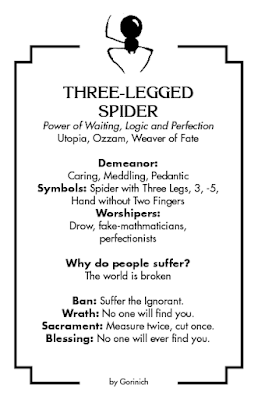
  4. Pacts Sealed in Blood: There are forces that you can swear on when setting a bargain. The Three Legged Spider, the Master of the Woods, The Devil. Breaking a deal sworn on one of them will have disastrous consequences, however gaining their attention is not without risk.

Discussion

Dropping the in character tone now becouse there are several things to say. First is that I'm ignoring one obvious way that a villain like this would work. If the villain is a monster themeselves, then they do not need to scrounge together various artifacts and hazardous cursed materials, they can just do this by thier nature, like Dracula does. Second, is there are classes that are already half monster, my last post is effectively such a class. Does that make mine and Ro's two posts on monsters part of the paladin bandwagon then or is this a new one? Anyway, I'd be happy if you rolled on these three tables and tell me what's wrong with the guy it spits out for you.

Tuesday, October 24, 2023

GLOGtober '23: Failed Gods and thier consequences

My first entry for this year's GLOGtober is slightly late, I was a bit stuck on this first entry. Now could I have set the first entry aside and first done a different one that was easier, yes yes I could have. For the first entry I rolled a 1, but couldn't think of something that spoke to me, so I rolled again, either as a replacement or something to combine with the first prompt, and got another 1. Damn what a coincidence, so I rolled my d6 again and can you guess what result I rolled that third time?

Challenge 1: Failed Gods and their consequences.


The Heavens do not weep, they bleed. A thousand years ago a being known as the Three Legged Spider attempted to breach the vault of the sky, to take the Throne of Heaven for itself. It successfully cut open the firmament, but itself was greviously wounded. The Heavens ooze thier ichor to this day, slowly cleaning out the wound. The poisoned divinity still drips down to earth, giving birth to monsters like Nothic and Ettercaps.


The Three Legged Spider, is a failed conqueror and a failed god. It lies curled up somewhere deep, deep beneath the earth. If you could find a shrine to it, and if it has any power left in it, these spells might be granted.

  • RAZOR LOGIC: select up to [dice] parts of the enemy's stats to temporarily cut out of existence. They no longer interact with that system for [sum] rounds. For example, razoring HP would mean the enemy no longer takes damage or deals damage. If you razored CHA, they can no longer make related checks or hold retainers. At 4 [dice] this effect is permenant.
  • BLACK HAND: For [sum] rounds, one of your arms turns invisible. You get an illusory arm on the same side that you can control freely. Small objects, like a dagger, held in this arm become invisible. The arm can interact with ghosts, pass through walls, etc.
  • SPITE:  Whenever the target creature would roll a critical success, it becomes a critical failure instead. Target will also feel anxious and irritable for the spell's duration. Duration: 1 [dice]: [sum] rounds, 2 [dice]: [sum] days, 3 [dice]: [sum] weeks, 4 [dice] [sum] months.


Gods are are destributed things, they are more patterns then entities. So what destinguishes a god from the background noise of existance? What seperates one god from another? The answer is the god's dream, each god is/has a dream of world.The Three Legged Spider's dream is a world of descrete objects where each thing is one thing and one thing only. Many gods blur together with thier sisters and have no issue with that for thier dreams are close, but to the Three Legged Spider it is a mark of failure.


We know that the Three Legged Spider lost it's limbs after it cut a hole in the sky, but how exactly that came about is a mystery.

Some say that the five Heavenly Dogs ambushed it and tore off a limb each, at which point it fell into the sea.

Some say that the five Heavenly Dogs each grabbed one of it's limbs, and to escape the Three Legged Spider, severed it's legs itself.

Some say that the four Heavenly Dogs cornered it, and decreed that to answer for it's crimes they will take it's limbs. The Three Legged Spider promised that it will never look upon the sky, if the Dogs swore to each take precisely 'a leg and fourth of that'. The hounds agreed believing that this would leave the arachnid limbless, not realizing that they promised to take an additional fourth of a leg, not a fourth of it's legs. They seethed as the smug bastard crawled into the underworld.

Some say that upon seeing the Heavens open the Three Legged Spider felt guilt for the pain it had caused. So in penance it sewed the wound shut, penitantly using five of it's legs as splints to keep the sky from collapsing.

Some say that it was betrayed. By far the most popular story. It's lietenant, it's closest friend, maybe even it's lover backstabbed the Three Legged Spider and stepped into the wound instead of them.

Five stories, precisely the amount of legs the Three Legged Spider doesn't have. 
They are all wrong.

Tuesday, September 26, 2023

Exquisite CΔrpse: Forest Law

 Sorry this post is a little late, I got distracted by things. Shout out to Xenophon of Athens, RandomWizard, semi-IDIOT, deus ex shit, Purplethulu, TheFirstGokun, Spwack, Sundered, Squig, theisticGilthoniel, Filth Pig and Phlox for participating. I have added a lot of connective tissue between these templates to tie them together, but left each delta itself unedited.

Spooky Deer

Δelta: Forest Law

Despite the best efforts of the Church, various heresies, secret societies and mystery cults hide within the cracks of society like weeds. Not all of them need to be rooted out however, many have been absorbed into the Church, or brought to heel or made allies. One such practice is the elven traditions of the Grey-Black Forests, which itself is built upon knots of compromises between it's people, it's trees and the Stag Lords. Thier traditions are strange, on one hand they hold to the virtues of impartial justice and purity, on the other thier lands have a hunting seasons not only for deer but human and elf. When a tiger eats someone in the Grey-Black you do not hunt it down, you bring the beast to court before a Forest Judge. Some Judges are rooted to a single community, others wander. Despite being heretical  it's considered good fortune to meet one, for they are known to carry with them waters of healing and wisdom.

To gain templates from a  rank of Forest Law you must have at least one template from the previous rank. Don't try to cheat this, the Forest can tell. As with many deltas, this list is not exhaustive.

0. Neophyte

To pronounce judgements, one must first prove they are capable of mercy. The conservitive judges may look down upon your initiation if you are neither an elf nor a local, but they can not stop you by the Law.

The Calling: (Xenophon of Athens)
  • Happen upon an injured or ailing wild animal. Treat their condition, and ensure they are healed. You can sense the locations of animals both wild and domestic. 
  • With a gentle mental pull, you can call them to you, and they will come in peace and friendship. You cannot speak with them, but you can exchange emotions non-verbally. If you cause harm to an animal you've called or located, you lose this ability.

1. Acolyte

To pronounce judgement in the Forest, you must understand it. To understand the Forest, you must understand it's waters. Clean and unclean, ill or hale, pure and vile. At this rank you are expected to follow the instruction of your seniors.

The Curing: (RandomWizard)
  • Call to a wild animal stricken with illness, and have them drink clean water from your open hands.
  • With an hour of searching in a wilderness area, you can find medicinal herbs that can cure (or at least slow) any disease. Children and animals in need of such treatment can instinctively sense that you can help them, and will come to you of their own accord.
The Cleansing: (Gorinich)
  • Call to a lost person with stricken with guilt and forgive them for what they have done. 
  • With good clean water and a little quiet you can wash away curses and profane powers. If you can't completely get rid of it, you can at least suppress it.
Take Me Up, Cast Me Away: (deus ex shit)
  • Confront someone in a place they thought was safe. Make them blind and deaf and dumb with a sharp blade. If they didn't deserve this, find another and start again. When they die, find another and start again.
  • When you look into someone's eyes, you can tell if they have seen evil and not confronted it, heard evil and not objected to it, or spoken of evil without condemning it. You learn when and where this happened but not what, specifically, they failed to do. If you remove the offending eye, ear or tongue you may immediately graft it onto someone else to replace a damaged or missing part.

2. Judge

To pronounce judgements, you must have the power to inforce them. There are a number of ways to prove your commitment before the Forest. You are now equal to your seniors, outranked by the Stag Lords, who are outranked by the King of Deer.

Unto The Silent Waters: (semi-IDIOT)
  • Take someone whose sins could not be forgiven by their victim or by two impartial judges of good standing who've heard their testimony. Drown them in the dead of night. Make sure their body is never found. 
  • In dark or murky water you can summon the revenant of the one you drowned to drag down another. If this is judged unjust by higher powers, then you will disappear into the next body of water you touch.
Hands of Glory: (Purplecthulhu)
  • Take the left hand of a thief and the right hand of a murderer, preserve them from rot, and wear them on your person. If you lose the hands, or use the abilities to steal or unjustly kill, you lose these benefits.
  • So long as you have the left hand, mundane locks click open open at your touch, and lights held by you are only visible by those you wish to see it. So long as you have the right hand, you can preternaturally sense illness, injury, and blood.
Blessed Child of Nature: (Spwack)
  • Go out into the wild with nothing at all. Return, well-fed, well-dressed, and well-storied. 
  • If you fought tough-and-nail to accomplish this challenge, then you can arm yourself appropriately, growing your teeth and nails with a thought and shrinking them as you like. If you relied on the benevolence of nature, then you can whistle back to songbirds and have them follow you about, sup with the King of Deer whenever you like, and be politely hunted by tigers.
Dryad's burden: (theisticGilthoniel)
  • offer to swap places with a dryad and have your offer accepted 
  • You now count as a forest creature, a spirit, a tree, and a woman for the purposes of ritual and law. Also there is a particular tree where, if it dies, you die. Burning it down is not generally enough, but a surprising amount of the dryads who swap with mortals were already dying of root rot or something. You can't exit the watershed that the tree is in, lest you die, but you do know that border at all times. Lose this template if you swap back.

3. High Judge

Techically no such rank exists in the Law, but those who rise high are considered first amoung equals. Be careful not to outshine the Stag Lords, who still outrank you in principle.

Clean Hands: (TheFirstGokun)
  • Wear neither foot coverings nor gloves. Do not touch that which is unclean with your bare hands or feet. Eat only from the hands of a devoted attendant, or with long, easily tarnished silverware. If you become dirty or arrogant, you lose these benefits.
  • So long as they are clean, your hands do the work of ten men and women. So long as your feet are clean, you walk, run, and jump with the strength of ten men and women.
Stag’s Salute: (Squig)
  • Bow to a reigning stag of a forest, and be bowed to in turn.
  • When you treat with rulers, be they human or otherwise, you will always be politely greeted. Peasants and smallfolk will typically identify you as nobility. If a crime is committed against you in a forest of a stag who has saluted you, you will be guaranteed a fair trial in their court.
Greedy Arborist: (Filth Pig)
  • Plant a tree in a location you have never seen nor been to
  • Any tree you have planted and the grounds within ten feet of said tree count as part of “your” forest for the purpose of travel, ritual and law.

4. Pariah

Also not a recgonised rank of the judical hiearchy, but the Forest has Laws older then the Antlered King.

Buck Spirit: (Sundered) 
  • Kill the King of Deer. 
  • All wild animals hate and fear you on sight. In addition, when you drink an animal's blood, you gain its most notable features until you drink another animal's blood, or you can turn into that animal for an hour, after which you lose the benefits of the blood you've drank.

5. Anathema

This is a rank is codifed in the Law. Judgement has been pronounced upon you and the verdict is death.

Grown to Purpose: (Phlox)
  • Water five of your trees with the blood of an enemy.
  • Wooden arms and armor crafted from your trees are as effective as +1 steel. When you craft such an item, you can give it a NAME with at least five meaningful words. If you are doing an action that fulfills that NAME, you can temporarily increase the bonus to +5, after which the item shatters forever.

Discusssion:

I may have been a few weeks late with posting this one, but with Exquisite CΔrpse 3 in the works I suddently felt the pressure to finally put up the post for Exquisite CΔrpse 2. Please do not tell me exactly how late I am.

I'm happy I was able to bring this all together into something coherent. Compared to the first one there was a lot less space for things to converge becouse there was only one round, and so it remained a bit all over the place. However I think I managed to bring it all together, the trick for making deltas make sense is specificity. Making Forest Law represent the religious/judical tradition of a specific region really helped bring it together. There are some gaps in abilites you would expect a 'judge' archtype to have, such as understanding of legal codes, however you can qualify for being a Judge by fighting for it tooth and nail to get Blessed Child of Nature, so I think Forest Law is a bit different from city law.

I think despite all the inconsistant quirks of the process a throughline does present itself. To become a judge you must first show that you want to help, then you can serve justice as restoritively or retributively as you feel is correct, but if you want greater power you must break taboos and it may or may not even be worth it.

Another note, according to the doctrine of anti-canon the Stag Lords can be anything from talking deer, to beastmen, to elves who wear antler crowns, but I must insist that the King of Deer is always a huge magical talking deer.


Friday, May 28, 2021

Arabus: Gnome Ann

 The wine-dark Arabus constantly churns out debris, dead fish and faiths. The Driftwood Papacy  scours along beaches and dredges with nets to rummage through these. Only the sturdy sea-bleached branches are kept, and only the suitably pungent carcasses are used for fish sauces, but each and every faith is kept. The Papacy is judgmental and rigid, but they are not book burners.

Each faith they find they rank, some are too Sputumous, others not enought, others are said to focus to much on Sweat at the expense of Tears, and so on. Sometimes faiths are found that seem to have both too much and not enought of the same humor, these paradoxes are usually resolved by finding a second humor that is being expressed in an unconventional way. Such as the recently uncovered Cult of Ieru, some early fragments uncovered by the Liturgist Elliot Cabal showed that they had an over abundance of Mucus, as the text goes into depth describing the inadequacies of spears. Another fragment indicates a lack of Mucus, in it Ieru's faithful are told to eat what is given to them without question. The current consensus however is that Ieruits did not lack Mucus, but ate anything out of a lack of Sweat. There is one deity however, for which the learned conscious is that they are both too Gastric and not Gastric enough. 


Doctrines and Scriptures:

Gnome Ann is an island.

There is an island among the Vineskulls, that is called Ann. No man lives there. Priestesses sworn to sleep with no man ferry pilgrims up the high cliffs to visit no man's shrine. Here people pray for things that can't happen, and too cope with the inevitable.

Gnome Ann is born wise.

No man was present to watch the Vineskulls rise from the sea. To have the first gnomes formed from sea foam and electric charge. No man was born 15 nautical miles south of Isle Ann, somewhere between the last century and maybe by the end of the next one. No man can be an island, a mortal women and a timeless god at the same time.

Time and tide wait for Gnome Ann.

There are things mortal souls can never hope to accomplish, they are frail, prone to sickness, doubtful and confused. Each person from their birth is bound to die. And yet, these same mortal souls can achieve great and terrible things, fragile boned birds have ascended to be the sun, great cities have been raised in which the gods can be forgotten, the Unliving walk despite it all. It's a puzzling paradox, no man knows what the their limits really are.


Practices of the Faith:

Or rather, game mechanics that are used to describe it. 

As an Idol in Marrow:

GNOME ANN Cast away something that can keep you safe to / gain a TREPIDATION. If you decide to not do something because your likely to fail /then for the rest of the day roll 3 dice and take the lowest when rolling with disadvantage.

TREPIDATION: Each one takes up a WIS slot, you can spend a TREPIDATION so that for a brief moment make one impossible thing possible.

As a Delta Template:

Leap of Faith:
At a high cliff Shrine to Gnome Ann, swear that you will fear no man and take a leap off it. In a pinch, any cliff would do as long as no one has leaped from it before. Lose this template if you become comfortable with your mortal limits.
When you cast aside something that can keep you safe, your hands tremble with TREPIDATION and you feel how far the horizon stretches. In this state you can do one thing no man can do, but only for a moment and then it passes.
If you ever turn away from a course of action because of it's difficulty, you will see all difficult tasks as impossible, until you do something no man can do or you get a good rest.

(Special Secret to not tell players: While the jump from the high cliff shrine looks intimidating, it's actually pretty safe. The priestesses will how ever play up the peril, by responding with cryptic silence when questions about the danger are asked, this is mostly hazing.)

Demographics of Worshipers:

In the Vineskulls most gnomes respect most deities. It's best not to piss anyone off you know? Gnome Ann is prayed to before embarking on an ambitious and dangerous venture, or to come to peace with one's failures. Individuals that dedicate themselves Gnome Ann are called Annites, their initialization ritual consists of the aforementioned Leap of Faith. Many Annites live on the island of Brobble, said to be the place Ann has or will be born, there they mostly keep their head low and quietly fish. Aside from being the port that leads to Isle Ann, Brobble is also known for how much women who love women live there. To the point that some gnomes refer to any lass loving lass as a Brobbian, even if she's never been there. You can find Annites abroad anywhere where you can find of batshit insane gnomes, they generally have big ambitions of some variety. A few succeed and become big shots somewhere or another, the ones that fail eventually end up coming back to Brobble, who welcome them as family.

There is one sect of Annites which is synchronized with Humorism to explain how Gnome Ann was able to become Gnome Ann and that anyone can do it too, which is utter hogwash. Their weird, they gastrically refer to themselves as Gnomsticism but they got like a handful of adherents? Nobody really likes them.

Sunday, December 22, 2019

Secret Santicorn 2019: Psychonauts- Courageous Healers or Conniving Thieves?

This year for the Secret Santicorn I received a request from Nick Roman that goes something like this.

A dungeon/adventuring location set in a dreaming mind. Are you rescuing them from a curse? Stealing a memory in an Inception-style heist? Trying to undo their amnesia and find their hidden true self? You decide!"

So, here's the thing about dream trying to create fiction that evokes dreams, if hard because the waking mind does not think in dream logic. Lucky I think the texts produced by GPT-2 have the dreamlike quality of almost but not quite making sense, so I've come up with rules that use Talk to Transformer as a secondary GM in charge of dream sequences. I don't know how good of an idea this is but it could work. Now, what I have is less of an adventure, and more rules for creating adventures, as a large part of the content is generated by a computer. Also someone please stop me before I end up writing a whole setting.


The Lore:
In recent years a strange kind of artifact has been discovered in the ancient ruins under our fair city. Gates have been dug up that allow you to enter the dreams of others. Each Gate is this ring about two horses in diameter and as thick as mast tree. From the touch it's smooth and almost warm like horn, and each Gate is unique in color and the pattern of it's ridges. Which is good because each one has a corresponding Crown that looks like the Gate in miniature. By themselves the Gates and Crowns are just feel in explicable alive, but when a Crown is put upon a sleeping person's head, than something magical happens.

The space within the Gate unfolds, and you can step into the dream of the sleeper. The dream is not like the waking world, it does not follow rules, at least not ones that make sense to us. However the world of dreams is also the world of thought, so the presence of a waking mind disrupts the flow of the dream, causing the "lucidity" of the dream (which is separate from the lucidity of the dreamer) to ripple out and swing like a pendulum. The common parlance among Psychonauts has come to refer to the periods of greater dream logic as "High Tide" and periods of higher lucidity as "Low Tide". But who can make out what the Psychonauts babble, it would be easy to pass them off as lunatics, stringing together patterns from nonsense and spewing philosophic drivel if the things they brought from the dreams were not so real.

At the time of writing, less than thirty compete sets have been discovered, and despite there not being any real understanding of where they came from and why, the public has really gotten excited by these circles. Dream exploration has become a cottage industry, and one that aims to help with so many psychic ills. Feeling depressed? Do not worry, it can be taken out by our best men. Have your been dreaming of writing your own perfect play, or marrying the perfect wife or having the perfect suit? Well, if you can dream it, we can fish it right out of your skull. Wish you could learn the classics but don't have time or energy? Well, we can  just take the classics, and shove them directly into your subconscious, no problem. Trust in us and our expertly trained Psychonauts!

There have been rumors that there is a dark side to the dream exploration business. That, the Psychonauts might rearrange a personality for their own ends, that sometimes they go in so deep that they can no longer get out, that sometimes nightmares escape instead. All baseless rumors, I assure you.

The Procedure:
Tools: A computer of some sort with access to this site. Fore the sake of convenience I'm going to refer to it as Transformer.
Setup: The GM sets up the computer with the site and writes "Dream Gravity" somewhere visible.
  1. For the Gate to open, a Crown must be on a sleeping person's head.
  2. The party enters the Gate and must weather the High Tide.
    1. The players comes up with a paragraph of description, that the GM inputs it into Transformer.
    2. The GM reads out what the computer spits out, that's what happens. During High Tide, the players just watch the dream unfold.
  3. After it passes, in the Low Tide of the dream, the party can act upon the dreamscape.
    1. This segment is like normal play, but common sense takes a second seat to the sort of tone established by Transformer.
  4. As the Tide begins to pick up again, after an encounter's worth of play, (however you define what an encounter is, say 10 minutes of play if want a ballpark) the party has to choose between PUSHING FURTHER or PULLING OUT.
    1. PUSH FURTHER: If the party pushes further, than 1d4 is added to the Dream Gravity total, and repeats the process from step 2, except this time the prompt is based on the last thing that happened in the dream.
    2. PULLING OUT: If the party decides to exit the dream they can just do so, but they have to roll above the Dream Gravity score for each dream thing they want to take with them, otherwise the thing stays in the dream.
      1. A "dream thing" is any noun you could take with you. Objects, creatures can be taken but not locations.
      2. If Dream Gravity is higher than 10, than each player counts as a dream thing as well.
  5. When the party gets out of the dream, the sleeper usually jolts away. And now it's time to determine how they have been effected and how any dream things interact with the waking world.
    1. Each dream thing represents some part of the sleeper's soul/personality/memory, the GM decides how this effects their character, and it can have some weird magical properties based on how it worked in the dream.
      1. The dream thing can also be used as a one time teleport back into the sleeper's consciousness without the use of a Gate or Crown.
      2. In the astral plane there is a clearly visible thread from the dream thing to the sleeper.
    2. Each thing that was left inside the dream, gains some metaphorical significance and changes the personality of the sleeper in some way.
    3. Every person left inside the dream, sticks around as a new voice in the sleeper's head, and can hijack control of the body if they beat the sleeper in a will contest. Treat this as possession. They can be encountered in the sleeper's head if the party goes in later, but their shape might be different, and they will might remember themselves only sometimes during Low Tide.
The Notes:
The way I have this system setup is to enmesh the Talk to Transformer website with a live human GM, I know AI dungeons exists but I haven't been able to figure it out so I wrote rules around the tool I understand. The concept of High and Low Tide is introduced so that there is a diegetic explanation for the changing between paragraphs of almost coherent computer narration, and normal OSR play. If there's a tangible in-world difference between the two states, than rather than being a weird game abstraction, it's a way to support the fiction of exploring a surreal dreamscape.

I made the main consequence of dream exploration a push-your-luck mechanic because the normal consequences of death and bodily harm don't seem quite relevant in this context. I like being stuck in the dream as a consequence, it tickles the part of my brain that likes tropes like "don't eat the food in fairy land" and "spend to much time transformed into a bird and you might forget you were every human". I don't quite have the words to explain why this feels right, and that's no accident because this subsystem is all about the relation between the conscious and the subconscious.

Dream things are meant to be the treasure that draws players to engage with this subsystem. The fact that each dream things a part of someone's soul serves the purpose of preventing the Gates from being free magic item machines and creates meaningful impact for the game's characters and world. The teleport-into-sleeper's brain that dream things have is a fail-forward mechanic. In that it provides an escape route for when your in a tight spot, but one that generates it's problems. Like how do you get out of the brain once your in there, and how is the npc going to feel once you teleport into him and so forth.

The sleeper wakes up when the party pulls out to prevent players from just quickly going in and out of the dream to reset Dream Gravity. Meaning that players generally only have expedition per person per night, which has the additional benefit that players get to see how they are changing a character's personality over time. Players can use drugs and sleep spells and other methods to get their target back to sleep, but that's ok because there is some opportunity cost of money, spell slots and side effects in some way. 

The Hooks:
While most of the adventure is generated in the computer, there is room to come up with why the players are going into someone's dream.
  • The Court Magician is sure that the King's recent slump is caused by demons he's being possessed by. Get in there and kick those suckers out!
    • The truth is that much to the annoyance of the King's advisers he's being suing for peace with a nearby kingdom, and as they need another war around now it would be nice for a policy change.
  • A painter who has lost the steadiness of his hands to age dreams of the same masterpiece night after night. He wants it retrieved so that others can marvel at it.
  • A man recognizes that he has anger issues, but doesn't believe he's able to change maybe you could help him.
    • There is also the question of what to do with that anger once it's outside the man.
  • A wizard has a business proposition, what if we traumatize some orphans, than extract their nightmares and train the resulting monsters to be guard dogs.
    • I mean, if we take the trauma out of the kids, than the kids don't have trauma anymore which makes this whole operation ethical.
  • A cult believes that if they move their entire collective into their high priest's head, than they will ascend into a higher being.


Saturday, September 21, 2019

Cultures of the Soupborn.


Famed-in-small-circles idea haver, David J Proskopetz had an idea about what if fantasy races had unique reproductive cycles. Most of that post isn't relevant to what I'm about to write, so I'll quote the part that really grabbed my attention.

"Goblins were created by alchemy as servants for an evil wizard, but immediately stole their own formula and rebelled. New goblins are brewed in big brass cauldrons full of exotic reagents; each village keeps a single cauldron in a central location, and emerging goblings are raised by the whole community, with no concept of parentage or lineage. Sometimes they like to add stuff to the goblin soup just to see what happens – there are a lot of weird goblins."

Now here's the thing that I love about this, is that there are a whole lot of ways you can take this. Goblins can have cultural distinctions based on how they treat the stews they are born from. They can have differing rules or lack of rules for what is allowed into the stew. Different names for their cauldrons, whether they have cauldrons or just pits in the ground, the possibilities are endless! I'm going to restrict myself to four cultures in this post thought.

But first some additions to the general idea.
First is the backstory, and how it's utterly inconsistent. While some claim a wizard made the goblins, others say that they rose from the blood of a god or that all life came from soup and everyone has strayed from the natural order of things.

Second is that one trait that goblins usually have is that they can smell and taste if there's something wrong with their stew. A bit like how how some people can smell if there's a cold on you.

Third, is that goblins are for the most part asexual, aromatic and genderless. That's not to say they lack love, they are social animals just like humans, but without as much focus on specific individuals. Where humans art and poetry is obsessed with the idea of the soul mate, goblins believe that finding the right squad will bring them everlasting happiness. This is a very general trend, but individual goblins are as varied as humans.

Lastly, is that the size of a soupborn is based on how long they have floated in the pot. At first a tiny little goblet is formed, than an additional layer coating after coating of goblin gets added. Most goblins are the size of short human because that's big enought to move not get crushed by absolutely everything but small enought so they don't have to eat that much. If you cut open a goblin, their flesh is ringed like a tree, this becomes more obvious the larger a goblin gets, which is why it's well known that ogres have layers.


Brewer Tribes
Hobs and gobs, sniggs and snogs, ogre, wogre, troll. They usually leave everyone alone in their swamps and caves, but sometimes the buggers will steal livestock or attempt to sell either infernal contraptions or get-rich-quick schemes. The one thing that they respect is booze. If you bring them a bottle they will treat you as a friend, if you can brew than they will treat you with reverence.

From the outsider's perspective a goblin village is a complete mess, while that is true there is system to it. The center of a village is the pit or if they are well off, the cauldron that acts as a central hearth and heart of the village. They are born from the cauldron and in death they are thrown back to the cauldron to reincarnate once more. Around the the cauldron is a ramshackle structure where goblins, congregate, eat and sleep. The air is moist and warm, the smell is potent and sticks to your skin, home sweet home. Around the main hut at variable distances are workshops,  tool sheds and storehouses for all the things that disturb the soup or would be disturbed by the soup, most importantly the breweries.

Witches hold a special position in this culture, as wise persons and keepers of power. Witches are defined as anyone who can brew booze, and their power and wisdom is ranked by the quality of their spirits. You can split mountains and make dragons bow with your magic, but if you can't make a good ale than your kind of a phoney in the eyes of a goblin. A number of tribes have been converted to not-christianity by monks who know how to make beer. Closest thing to a king or chief in a goblin tribe is a Spoon Master, who has a few important duties, first to stir the soup for optimal thickness without killing any developing goblets, second to fish out the goblets once thier ready and finally to veto bad additions to the stew, traditionally with a smack of the spoon. Another important tradition is that Witches get more sway in the bickering over the soup.

GLOG Racial Features:
Perk:
Mutation: Roll for a mutation on a nicer mutation table.
Drawback:
Mutation: Roll for a mutation on a meaner mutation table.

Or roll on the Scrambled Race Table.


Armies of Darkness
The troops of the dark lord. Orcs and ogres, gretchlings and hobgoblins. Wretched things with clawed hands that pillage and plunder. They break and crunch all things beautiful and spit out mush. They only live by pain and hate. Their unfortunately easy to produce as well once you secure a cauldron. Many a petty warlord and maniacal wizard use them as canon fodder in their armies. It's growing increasingly common that wars aren't fought by noble knights but goblins pitted against each other in terrible brawls.

A goblin born in a war cauldron is a pitiful thing indeed. They don't have any access to it for one thing. human or other monster keeps a tight control over it, which leaves the goblin alienated and effectively orphaned. This also makes a goblin born ill for cruel lords don't fuss about a brew as a goblin can and will. Cruel lords demand obedience from goblins and punishes the slightest error. Thus a goblin learns deceit and duplicity. Cruel lords tell goblins that they are made for a purpose and must serve it, and the poor goblin tries. Needless to say, goblins make for horrible soldiers and while armies of darkness always cause a lot of history to happen they really bring victory.

It's frightfully easy to get an army of darkness to turn against it's master. A single spark of hope or a little bit of truth is enought. There are several tricky bits thought, they generally react poorly to overt good and nice things, if it looks to good to be true they will suspect a trap. There's also the issue what do they do once their free.


GLOG Racial Features:
Perk:
Grunt: You can effortlessly feign loyalty, appear to be busy and lie with a straight face. Most people will underestimate your intelligence by default.
Drawback:
Mutation: Gain a random mutation, from a mutation table that has a fair few nasty results.

Or roll on the Scrambled Race Table until you get something kinda pitiful.


Wild Things of the Arboreal Forest
Orc, woodwose, beastman, trolls. These fanged and shaggy creatures carve eyes on their spears to always strike true and teeth on their shields to break the opponent's blade. They pay homage to the master of the Boar's Wood, an old and brooding god. They are renowned for always seeking out the biggest toughest thing to fight. An average one can wrestle a bear into submission and their champions are rumored to have suplexed giants. They are often found in mercenary companys but always side against the strongest side and don't accept coin for their service. They only throw great beasts and mighty heroes into their pots, to ensure that the next generation grows up stronger, smarter and deadlier. Orcs are known to even raise powerful monsters for the purposes of the pot.

While the culture of the beastmen is focused on the idea of glory in combat and always taking on the baddest guy in the room, they still have a sense of self-preservation and personal interest. If an orc band hears about the death of a dragon they are just as likely to challenge it's slayer as it is to murder them in the dead of night and taking credit for the feat. While they do have a reputation for not taking pay, they work under the assumption that they will be given gifts generally of live-stock and weapons. Most will decline any gifts given to them but will become upset if you don't insist on giving them what they want. The greatest honor a woodwose could receive is to be thrown into the pot, supposedly for deadliness in battle but it often ends up that the most popular and well liked wose get in there. For many wose this actually a relief because one has to be thrown in during the prime of their life. Outsiders are offered this honor more often than beastmen actually. In some cities, the idea of a "wild son" is recognized for when a beastman displays traits of a hero given to the pot. The recognition ranges anywhere from being equivalent to normal offspring to being bastards to being the originating family's property. The city of Vrast has gone as far as to make beastmen to be it's warrior caste.

GLOG Racial Features:
Perk:
Beast's Mutation: Roll three times on a mutation table, pick the one best suited for hunting and/or fighting.
Drawback:
Appetite: Need to eat twice as many rations.

Or roll on the Scrambled Race Table, until you get something sufficiently beastly.


The Folk under the Mountain
Dwarf, dvarger, gnome. If you ask a dwarf how it was born, they will scoff and say that they are forged from living metal. Like goblins that don't have parents in the human sense. There are the Deep Smiths that made them, but they don't raise gnomes. They stand distant and revered, working in their secret foundrys attended by masked spirits who barely speak in whispers. A dwarf is raised by their mentors who teaches them both the culture and craft of their people, just as their mentor did for them. Lineage is tracked through the bones, which are made of durable metal, rather than the perishable living metal. The souls of ancestors past are always with a dwarf, and are said to aid them in their time of need.

You may ask as to why Dwarves are mentioned along side others born of the soup if they are forged? Well, it is a half-truth that dwarves are made of metal. Their skeletons are honestly forged, but "living metal" is not different from normal goblin flesh, it just grows around a titanium skeleton. The sacred smithies of the Deep Smiths look more like alchemical labs, where they spend day and night making sure that the soup has the right heat, the right amount of salt and the correct viscosity to produce ideal dwarves. The ones who turn out wrong either get killed or raised to be masked spirits that bare the gnomish secrets. In some holds they act as servants to the Deep Smiths, in others the Deep Smiths are more like go-betweens between the masked ones and the rest of dwarven society.

Such a secret would be to large to keep, deep down most dwarves are vaguely aware that something doesn't quite line up. They however ignore and rationalize away the inconsistencies just like humans do about their deeper secrets. Don't compare a dwarf to a goblin unless you want an ax to the face.

GLOG Racial Features:
Perk:
Fixate Bones: Your joints can be locked in place. You stand still for hours or hold a a hand position for hours without any movement or muscle cramps. Does take a moment to lock and unlock thought.
Drawback:
Heavy: You cannot swim, you sink like a stone.

If you want to play a Masked Spirit, you get the normal dwarven features, a mutation and a mask riveted to your face.

Post Script:
Does this count as part of the dwarf challenge? I do describe dwarves here, and I have participated in recent dwarf discourse, but this post is mostly about goblins.

Wednesday, January 2, 2019

The Power of Names

On the OSR discord I had some musings on a leveling system where you gain levels when you gain a name. From there I started brewing ideas for it.


The Bestowing of Names

When you receive a Name you gain a feature, increase your HP by 1d6 and roll you're attributes. If you roll above an attribute, increase it by 1.

Any nickname, title, honorific or what have you cane be a Name if it has the right power behind it. This power can come from several sources.The feature can get from a Name must be thematically appropriate. You can't give you're self a Name.

  • Gaining a reputation in a sizable town that most of the population knows about.
  • Having you're current reputation in a sizable town be overshadowed by something else.
  • Gaining a noble title.
  • Rituals a union of like-minded individuals are employing upon you. (literally Union Rituals but with added titles.)
  • With a month of time and instruction from a master.
  • Magic can bestow a name on you, but at what cost.
  • Dragons can give you Names simply by calling you something, you generally don't want this to happen.


You start the game with two names. One is you're True Name which allows you to have an Identity and a second one based on you're background.

Names can be bestowed on a group of people like an adventuring party, in which case everyone in that group will gain a Name relating to that shared group's identity. People keep group Names if they stop being active members, but lose them if they separate themselves from the group. New members don't get the Names associated with their group by default.

Glory

One straight forward way to get a name is to find out what the largest most impressive thing to do in a particular town is and do it. This can mean slaying the local dragon, going in and out of a near by hell-hole in one piece. It doesn't have to be something the town will like either, you can burn down the orphanage or pee on the mayor and that will give you a Name, it will however start showing up on wanted posters thought. The feature you gain from a Name can be a disadvantage and will always reflect the act that caused the name so be weary of that.

You don't actually have to do anything cool or impressive, you just need to get a town to believe you did something impressive. This is it's own challenge because if you steal credit for something than you have to deal with whoever you stole credit from, if you want to orchestrate a crisis that you can come in to save, that also takes effort and has plenty of opportunities where it can fail. If you are found out than you might gain the Name of Lier, Charlatan or something similar, which will increase you're stats but also give you the special feature of "can't tell the blunt truth", instead of something beneficial. As it can't be a name you've given your self, you can't just waltz into town claiming to be The Dragonslayer, you need to get npcs to start calling you the Dragonslayer of their own accord.

There is also a natural ceiling to how many Names you can get, because once a town has a Name for you it will continue referring to you by that name. If you want a new Name from somewhere that you already got a Name at, you need to do something bigger than what you did previously or something more scandalous. So you're best to increase you're power and renown is to either traveling from town to town preforming great deeds or preforming strategically large and larger deeds in a single town over a large time. Also if you have a wanted poster hanging up in every village, you're growth will be stifled because everyone in the region will refer to you by your outlaw Name, this is intentional on the part of the government. Also people will treat you with suspicious if you don't give you're name unless are immediately offering to solve whatever local problem the people here are having.

Professional Secrets

All specialized skills that would require yo go to a college or become an apprentice to a master also have require Name, which you get either with you're diploma or from you're master once you're ready. Thus, all blacksmiths have the Name of Smith and the Dr. of a doctor has metaphysical power behind it. This applies to magic users as well, and the difference between casters and carpenters is one of degree than of kind. Making any craft from a sword to a table is as much an enchantment as cursing someone, except the power is infused slower and subtly over a longer period of time, making it more reliable, stable and not dispellable. The smith also won't age rapidly from creating a fine weapon, at most he get's tired from it*.

Gaining levels doesn't make to much sense if you look closely at it in many rpgs. Into The Odd handily solves that problem by throwing the concept out all together**, but it also means that it doesn't have a handy way to represent characters gaining new skills. You could simply rule that you use downtime to learn something, but than there's still a little voice in my mind bugging me how this isn't representative of reality if I feel the times it takes to learn things are off. So my solution is to make my elfgame not work like reality but by something like story logic.

Incantation

Incantation has two requirements that need to be filled for it to work. First you can only target specific Names, and second the incantation needs to be successfully communicated. It can be communicated in any way, from speech to writing to interpretive dance as long as the recipient of it is able to understand it.

Unwilling targets of incantations get Will saves. Except it they are unstable and you use their True Name.

Sigils are specially prepared symbols that can store Names within them, unlike normal speech or writing that reference Names. Traditionally they are placed in scrolls or runes but it varies from culture to culture. If a nobody(see Lost Names) comes in contact with it than they will get that name instantly.

Due to the first requirement, you usually can only use your magic on specific individuals or the first member of a certain group or profession as those most often share names, and it's really difficult to incant animals or foreigners. If an incantation doesn't find a valid target, it will float around in the either indefinitely until it does.

Incantation can change mutate or corrupt the Names and their meanings or features, it's much to crude for that. The subtle art of storytelling is what can do that.

Stable beings are defined as those that aren't unstable. Unstable beings are ghosts, demons, magic users, illusions, gods, and people under great amounts of mental duress.

Compel

You can command someone to do something within their power as long as it doesn't go against one of their Names. For stable beings this costs 1 attribute point, for unstable beings it costs 1 HP. If you have their True Name you only need to spend 1 HP to compel stable beings, nothing to compel unstable beings.

Generally killing friends and family goes against most people's True Names, and acting against a person's core values, and there would be more restrictions based on the more Names someone has. People however have no mystical obligation to follow their Names. There are no incantations that can force a Doctor to break the Hippocratic oath, but the same Doctor can commit as much malpractice as their free will or the Shadow Caster standing over their shoulder desires.

Demon Names are generally not meant for this plane of existence, so despite how they would things like things to go, they can be compelled to banish themselves from this world. Very pious people can compel demons without any formal training to the annoyance of formally trained incanters.

Shift

You can move a Name from one place to another. For 1 HP you can swap two Names, for 1d6 HP you can move one Name from one target to another. You cant Shift to and from any valid Incantation target, yourself and sigils. Names can be shifted from sigils to people without expending any HP.

Acts attributed to someone with a specific Name will be remembered as having happened to the person who currently has that Name. So if John the Dragonslayer, has is second Name stolen by Jill the Witch, every will remember Jill slaying that dragon instead of John. Observant and informed people can recognize that these memories are false fairly quickly. John and Jill both know that Jill didn't slay the dragon, but Bob who lives across town might not notice the change in memory, especially if the event happened a while ago.

Dub

You can give someone a new Name or place one into a sigil. If you spend 1 HP you create a weak False Name that lasts until it's exposed to doubt about it's reality or the target falls asleep. False Names don't effect attributes or HP, but can change . If you spend 1 Attribute point than you can create a strong False Name that exists until a mystical condition is fulfilled. You can give someone a real Name by burning 2 max attribute points.

Erase

You can make weak False Names disappear with barely a thought. You can erase a strong False Name by spending 1 HP, and preforming some gestures in reference to it's mystical condition. You can annihilate a real Name by burning 1 max attribute point.

Call

By spending 1 HP you can call a creature to you. If they are stable beings than they will feel that they now know where you are, how to get there and have the desire to get there. If they are unstable they will instantly appear before you.

You can set a Name you have to allow others to use this ability on you. You can prevent being teleported from this, if you're not being called by an incanter.

Demons are always pressing in from the other side waiting and listening, so calling them is easy.

Lost Names

When you lose you're name bad things can happen. If you lose a name that isn't you're True Name than you're not that messed up. You lose the feature you gained from that Name, you lose 1d6 max HP, and 1 max attribute from the attribute most relevant to that Name, or a random one if none make sense. Everyone(including you) will have a hard time remembering things relating to you and that Name, you don't lose any memories they are just more difficult o access. Like trying to find old things in the attic, it's there but you need to spend a bunch of time or get outside help to get in. You are weaker than you once were, but you remain yourself.

Yes this can mean that you lose attributes and HP amounts that are entirely different from what you gained from that Name. I don't mind this, and even like that someone who lost a Name is diffrent from how they were before they had that Name. If it bothers you than write down the HP and Attribute gained next to each Name.

If you lose you're True Name than everything than all the same rules apply except the feature you lost is having a living and flexible human identity. Without it you have to make due with the other names you have, meaning that you can only be related to in terms of those other Names. So if John the Blacksmith lost the name John, he would just be the Blacksmith and would only be able to interact with the world in terms of worked and unworked metal, hammer and tongs, iron and steel. His ability to form and maintain relationships that don't relate with his craft would cease, but he still has human social needs despite not being able to put into words that he has them or having the concept of self necessary to understand that he has them. Those with multiple Names are have to consciously switch between them as the True Name is what keeps all the parts of the mind running cohesively between each other. So if the Blacksmith who was once john is the Blacksmith Dragonslayer, and a conversation about anvils changed into a conversation about dragons, he'd have to pause a moment to do so, and his posture will viably change from that of a reserved and careful Blacksmith to that of a triumphant and devious Dragonslayer. If you don't have a unique Name than  magic that tries to track you might pick up someone with a similar Name instead, so divining for the Blacksmith can result you the one who was john or any other Blacksmith instead.

If you lose all you're Names, than you become a nobody. Everyone who knows, loves and hates you has forgotten who you are beyond a vague impression, a stranger even to you're self. You cannot be tracked by sorcery or by hound. You're footprints are not footprints, they are just indents in the ground. The sounds you're mouth produces are understood to be words only when attention isn't payed attention to them. A bored merchant can accept your money and give you goods, and people will respond when you greet them but not much else. You are also free to go anywhere without being questioned and do anything without being recognized for it later. Cats, children and madman can recognize you thought, the first because the rules don't apply to them and the later to because they don't grokk how the world works, and because they can recognize you they can name you giving you a new identity to their liking.

Big List of Features and How to Get Them

Aside from all the interesting options, you can also have a Name that grants you advantage on something related to how you got the Name, which I won't list here for now. I'm not sure I'm happy with this list at all, but this post is already getting very long, it'll do for now.

Features from Achievement

  • Danger Sense: Advantage when surprised in combat intuitive. 
    • Gained from the reputation of miraculously surviving an attack.
  • Brave: You don't need to make moral checks on anything less terrifying than a dragon.
    • Gained from showing bravery.
  • Favored Enemy: Attacks against a certain type of foe are enhanced.
    • Gained by committing war crimes against you're favored enemy.
  • Oath Breaker: You can fake taking an oath or signing a contract without giving the slightest indication of doing so, and are immune to magical retribution from doing so.
    • Gained from breaking an important oath.
  • Vampire: Gain 1 ration from 1 Strength of blood drained from the coerced.
    • Gained from great acts of cruelty and exploiting people.

Professional Secrets and Arcane Practices

If not stated otherwise, you need to go to a school or a master who has it.
  • Incantations: See Incantations section. These are all separate features that follow the same rules.
    • Compel: See Incantations section.
    • Call: See Incantations section.
    • Shift: See Incantations section.
    • Dub: See Incantations section.
    • Erase: See Incantations section.
  • Shadow Art: See my previous post. These are all separate features that follow the same rules.
    • Domain: See my previous post.
    • Edict: See my previous post.
    • Conjuring: See my previous post.
    • Enchantment See my previous post.
  • Burn Essence: See my previous post, but with the added not that it works with different magical arts at different price ranges. It's effectively a "cause random undirected magic" power.
  • Medicine: You know how to treat wounds, and what herbs and substances do what to the body. Can preform surgery.
  • Blacksmithing: You can forge things with metal given a forge.
  • Literacy: You can read and write and read between the lines of complicated texts.
  • Misdirection: You don't need to roll for subterfuge or slight of hand if you're target has their attention on something not directly related to what you're messing with.
  • Bushcraft: Can track and forage with advantage or something more mechanically appropriate if you have more details wilderness rules.
  • Pact Binder: If you mediate an agreement or contract between two parties, it's metaphysically binding. If someone from one side breaks it they take 1d10 damage and the other party knows instantly.
    • You can also gain this if you successfully mediate a conflict between two forces.
  • Animal Handling: With a steady gaze and calm voice you can calm animals you have no right to calm. With time to can train calm animals.

Blessings

  • Turning: Weak Undead will flee from you. Stronger Undead get a save not to.
    • Gained from a ritual in dedication to the god of undead-hating.

Curses

  • Liar: Cannot tell the blunt truth.
  • Coward: Always fail moral checks.
  • Spineless: Cannot go against a direct Order, but Advantage when following them.

World-Building

  • People generally give their secondary Names or powerless names to strangers, but will give their True Names once trust is earned.
    • This is convenient, because we all refer to random npcs by their profession or allegiances anyway. The GM doesn't need to come up with any names untill the players take an interest in a particular character.
  • People without True Names can continue existing for a long time in large cities or on the road without anyone noticing, and they inevitable snap and go mad.
  • Spys will send each other messages inlaid with secret commands that cause them to  write out a secret message for the spy to read. Once they wrote it out, they burn it to keep it secret.
  • The barbarians are nervous about the whole writing thing for completely sane and valid reasons.
  • More literate people are more vulnerable to incantations.
  • InfoSec Witches fight secret wars with Name-Stealing Sorcerers.
  • Fairies can mess with you're Name effortlessly and will do so capriciously.

*This is HP loss, which represents exhaustion from near misses. HP spent to craft things isn't tracked and doesn't actually matter, except to say that craftsmen are more vulnerable right after they finished something. I'm also going to rename HP to Stamina when I write my Oddhack, so that spending it is clearly exerting yourself.
**The design goal of ItO is minimalism not verisimilitude but shh...

Wednesday, December 26, 2018

Shadow Magic

The spiteful Sun glares down on us all with he's aloof and amused smile. He is so great that he's power is felt merely from he's presence. The reason why he's rays radiate into arms is because everything the Sun sees, the Sun controls. For such a being, the two are identical. However, this isn't complete omnipresence, because where the sunlight doesn't touch, the sun holds no domain. Within each shadow is an unsupervised zone out of the grasp the celestial spheres but too small and isolated for chthonic powers to claim. Once you know this you can use this loophole, you can leverage it for your self, and once you've practiced that long enought, you can control it, and if you can control it that you can be Onto A GOD... within an area between a few to 60 feet demanding on time of day and if the weather allows.

This is intended as a replacement for the archetype of the fantasy wizard for my yet unnamed setting. Well, partially, there are are other magical arts that I have yet to write up that are meant to be complimentary to this one, and Mancy exists in the setting as it's own thing. Spell ferrets still exist in the world. It will make sense when I write all the various things out and organise them properly.

This was made with Into the Odd in mind, with my own leveling system that I have haven't gotten to writing down yet, but will soon. I might trash that idea in the end. Any way.

Ironic that how I messed up the lighting in this drawing.

Shadow Caster:

When you become a Shadow Caster you start with Domain, Burn Essence and One of the 3 Shadow Arts.

Domain:

You have subtly control over what is in you're shadow, allowing you to cause minor spooky stuff to happen inside it at will. If you're shadow overlaps with a large unlit area, the energy disperses making you're Domain not work and causing all Shadow Arts preformed to cause vague spooky stuff instead.
*Any action or attack against you from within you're shadow has disadvantage or is deprived respectfully.
*You get advantage against anyone within you're shadow.
*If someone dies within you're shadow, than their spirit is stuck in there and has the ability to cause spooky stuff and warp the shape of the shadow. If you're shadow overlaps with an unlit area, spirits can escape from it, should they want to.
*Arcanum and Spells have their range extended as far and wide as you're shadow. Within reason.

Burn Essence: 

You can consume parts of you're self by spending hit points or any attribute points to power you're magic according to the table below. Burning yourself causes you to age rapidly and shrivel up.  You can burn more essence than than the amount listed on the table to increase the power of a casting. You can also burn essence without a goal to make intense spooky shit happen.
DurationExistenceScopePower
ConcentrationAs long as you Focus
on it
Will vanish if seen by the sun.Size of head.Instantly lighting
 a Candle
1 Hp BurnedTo the next
Sunset or Sunrise
Will vanish if convinced
it doesn't exist
Half of a PersonInstantly lighting
a Campfire
1 Attribute BurnedIndefiniteWill vanish if convinced
it doesn't exist 
Size of a PersonInstantly setting
a Wagon on Fire
5 Attribute BurnedPermanent.It's Real now. Edicts
become part of a person's soul.
Anything that is in
you're shadow
Instantly incinerating
 a Wagon

Shadow Arts:

Edict: 

You can give up to 7 word command to something or someone within you're shadow. They are under the effect of the Edict for a Duration. Edicts has Existence equal to their Duration. Normal creatures get will saves, erratic ones like undead, demons, shapeshifters, wizards and emotionally distressed people don't. Inanimate objects don't get a save, they either follow Edicts or don't depending on Scope.

Conjuring: 

You can create illusions, phantasms and glamours within you're shadow. They act exactly like real thing, except that they are limited by Existence and Duration. You can conjure not particularly intelligent creatures, disguises that cover the surface of something with a different surface and so forth.

Enchantment: 

You can infuse part of you're self into an object or a shadow. The enchantment has Duration and Power while effecting something with Scope. It either allows you to create a random arcanum using something like the Maze Rats spell generator or allows you to place some function of what you can do into an object. Like losing sight in one eye to allow you to see through a brick or giving up speech to make a statue speak. The function will return to you once the duration is up. Enchantments that burn attribute points are downtime activities.

Design Intent:

If you've read my blog, you'd already know that I'm somewhat hung-up on ideas of magic and technology and natural rules of the world. The intention with this system is that it's what comes about as a result of the natural laws of the fictional universe I'm making. The rules that this class relies on are eluded to in the flavor intro and mechanical rules but directly spelled out. Hopefully they don't need to be directly spelled out, as they are fairly intuitive and grokkable.
Another intention of this design is to make environmental conditions an important part of the strategy. It matters for a caster if the it's sunny, what time of day it is and so on. If the conditions are just perfect than you can put very strong foes to their knees, but if they are slightly off than you can easily get screwed, so ambushes and Combat As War is the best way to go, if the plan does fail you can go nuclear by burning you're self entirely. Effective casters also need teamwork to be most effective, someone to carry and angle the torch, meatshields that can protect them after they burned essence to pull off some big effect and so on. Arrogant and uncareful casters can easily be defeated by a foe that's clever or lucky and doesn't have any mojo. To sum it up, I want knives in the back to really cramp these wizard's styles, both in when the knife holder is a player and an NPC.
Edicts are meant to make the caster intimidating and domineering presences when they can catch someone.
The purpose of having those that die in you're shadow getting stuck in your shadow is twofold. First is to give a consequence to commanding someone to commit suicide that is more interesting than denying the option, because if the ghost of someone you killed is stuck in you're shadow, they are not going to mess with you're magic and that's something you'll have to deal with. The second is it allows for the trope of "shadow does something else than the body" without just giving that ability to the player, because that would lessen the need for wacky lamp contraptions that change lighting angles. You can control you're shadow indirectly if kill a dog within you're shadow, than train the ex-dog to follow you're commands to stretch and warp in whatever way you need. But a dog needs treats to be trained, but what do you feed a ghost dog? Why you burn hit points for it of course, what could go wrong! Thus you can have both crazy lamp contraptions and casters sicing commanding their shadows to do things, and both have their advantages and disadvantages.
Conjurings being vanishible by convincing them they don't exist was stolen from Martin O, for the reason that I find the idea quite amusing and having unsettling implications when it's also the same power that allows you to create real things from mid air. It supports the theme of having a blurred line between reality and artifice, sorcerer and charlatan which I am partial to.

World Building Implications and Tangents

  • Wizards wear tall pointy hats and bellowing cloaks to have longer shadows.
    • Wizards have towers for the same purpose. Enchanting a tower in it's construction will make it on some level a part of the wizard.
      • Wizard towers take a lot of money to build, as such they are usually implements of war and are feared as such.
      • If a wizard dies than the expensive expensive tower will be useless. This is solved by a ritual where a wizard's name and beard are passed down to an apprentice. The Beards of the greatest tower wizards are cultivated through generations.
      • Some wizard towers are more tower than wizard.
  • In the mountains there is a magical tradition that casts shadows using gliders. Despite having no means of propulsion the gliders have great maneuverability as they can conjure wind from beneath them, and they can terrorize their enemies with impunity. (This idea originally came from Spiraxo on the OSR discord.)
    • Dragons and ravens are also known for the use of aerial shadow casting.
  • You can buy potions that have wondrous effects but can't be exposed to the Sun. So you need to drink it carefully and it will fail if you spit or bleed.
  • There are illusionary people who don't know their illusions.
  • In some cultures it's impolite to step on someone's shadow and in others it's impolite to cast you're shadow on someone.
  • Homunculus are small because artificially making a fully sized human would is to dangerous.
  • Casters who have enchanted marionette minions mock those who use enchanted skeletons as being cheap, while the later call the former pretensions.
  • Magic items are weird and at times stupid because their creators don't really get to design them.
  • The Fey are able to weave enchantments and conjure wonders without withering before everyone's eyes.
    • Fools try to capture and eat them. Generally doesn't go well.
  • You can Curse Flesh just be being very angry.
  • There is a Caster who was able to survive underground by conjuring food for himself to eat. Now he cannot leave the caves because if he does than he'll disappear due to many months already having pasted out in the world.